


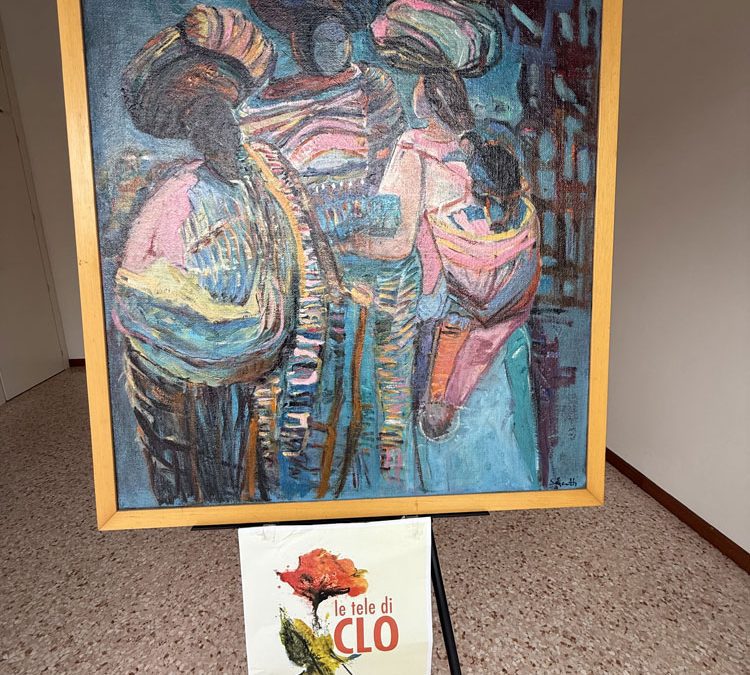
The work depicts a group of African women who, with the "headband" on their heads, stop to chat while carrying out their daily activities. The moment captured by the artist is not just a snapshot of communal life, but a celebration of femininity and community. These women, perhaps belonging to a tribe or simply united by their being "women", share thoughts, stories and complicity. The absence of details in the faces emphasizes the universality of the scene: these women could be anyone, becoming a collective symbol of sharing and mutual support between mothers, workers, friends.
The predominant use of blue envelops the scene in a profound, dreamlike atmosphere. Blue is a color associated with calm, reflection and spirituality, but it can also evoke mystery and nostalgia. In this context, it seems to frame and amplify female voices, making it almost audible even if not concretely perceptible. The artist uses color expressively, suggesting rather than describing, and leaving the viewer the freedom to immerse themselves in the painting and construct their own narrative.
Schenetti, despite being known for other techniques, in this work demonstrates a refined mastery of oil painting. This technique, with its ability to create depth and color variations, gives the scene an almost three-dimensional quality. The brushstrokes appear soft and fluid, contributing to a sense of movement that recalls the chatter of the women and their invisible bond. The faces mentioned, perhaps deliberately blurred, suggest mutual listening, an interaction that transcends words and is expressed through simple being together.
An interesting element is the "cercina", the load that women carry on their heads. Its contents remain an enigma: food, clothes, thoughts, dreams? This ambiguity allows different interpretations:
If it is about food, the painting can be read as a celebration of care and sustenance, fundamental aspects in female and community culture. If they are clothes, we can see the link with tradition, identity and craftsmanship. If, however, it symbolizes thoughts and worries, then the work becomes a more intimate reflection on the responsibilities and role of women in society.
Schenetti does not offer us definitive answers, but invites those who observe to actively participate in the work. The viewer is asked to imagine the content of the circles, to understand the tone of the conversations, to decide whether these women are long-time friends or simply temporary companions. This interpretative openness makes the work alive, dynamic and always new at every glance.
With this work, Clò gives us a window into an everyday moment that transforms into a universal symbol. Through the enveloping blue, the refined technique and the symbolism of the elements represented, the artist creates a dialogue between the figures in the painting and those who observe it.
It is a work that invites us to reflect on the strength of female sharing, on the beauty of simplicity and on the value of unspoken but perceived stories.
Tina de Falco