


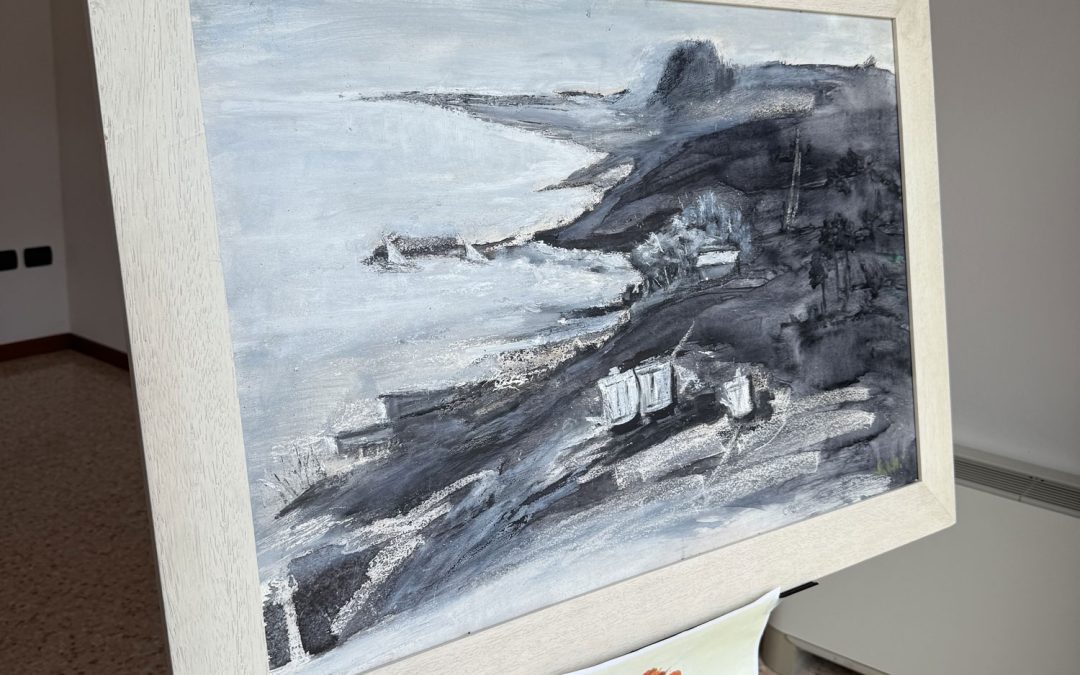
The ink and wax work we observe is not just a landscape: it is a condition of the soul. In black and white, devoid of any chromatic frill, it restores the visual and narrative power of an ancient photograph, as if time had already left a patina of melancholy on it. The sea, a silent protagonist, opens before us on a November day, cold, grey, inhospitable. There is no storm, no explicit drama - just a cold calm, capable of delicately suggesting an end, the conclusion of a summer that will not return.
The skilful use of inks, combined with the opaque softness of the waxes, creates a visual texture that amplifies the sensation of suspension. The pictorial material does not scream, but whispers: every stroke is considered, every void is eloquent. It's not just a place, but a state of mind.
The landscape seems to belong to Northern Europe – but it could be anywhere, because its true space is that of memory and reflection. The houses that silently overlook the coast appear motionless, as if inhabited only by thoughts. No human presence animates the scene, but you can perceive the traces of those who lived there, observed, loved and then left.
This is a landscape of waiting and remembrance. A cozy, almost sacred place, where time seems to have stopped to listen to the stories of those who sat down to watch the sea. Here then the work becomes more than a representation: it becomes an emotional mirror, a space open to silence and contemplation.
The artist Schenetti manages, with few elements and a limited tonal range, to evoke a complex world: the one that stirs within each of us in moments of transition, of loss, of rethinking. A work that does not ask for answers, but offers listening. A work that remains.
Tina de Falco